
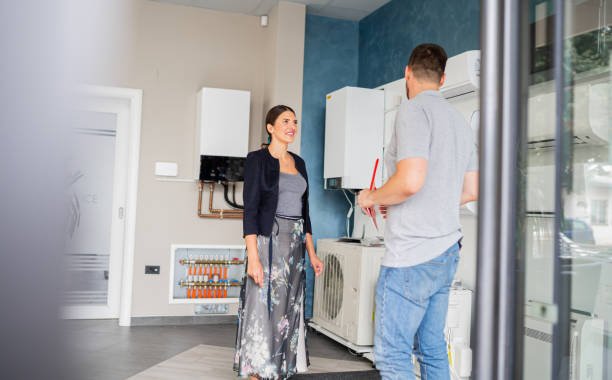
In most Houston homes the furnace and the water heater share a closet. They share the air in it, often the flue that carries their exhaust out, and frequently the same drain pan on the floor. That means two different trades look at the same small room from two different angles, and a homeowner who understands both sees problems before either technician is called. It also means that when one trade changes one appliance without looking at the other, the closet is where the trouble shows.
This is what each trade checks in that closet, why, and the handful of things any homeowner can check between visits.
Why the closet matters
Gas water heaters and gas furnaces both burn fuel, and burning fuel needs air coming in and exhaust going out. A closet that was fine in 1985 with a louvered door becomes a problem when someone replaces the door with a solid one, stacks boxes against the units, or swaps in a higher-output heater. The air supply drops, the burners run rich, and exhaust that should go up the flue spills into the closet instead. That is the carbon monoxide scenario, and it usually starts with something as small as a door.
The rule of thumb codes use for appliances drawing combustion air from inside the house is 50 cubic feet of room volume for every 1,000 BTU per hour of input. A 40,000 BTU water heater and an 80,000 BTU furnace together need about 6,000 cubic feet, which is a large room, not a closet. So a closet needs openings to the rest of the house or to the outdoors: typically two louvers or grilles, one within 12 inches of the ceiling and one within 12 inches of the floor, each sized to the appliances. Block them, and the math fails.
The closet also collects water. A water heater sweats, leaks at a fitting, or eventually fails, and the furnace next to it has electrical components a few inches off the floor.
What the HVAC tech checks
| Item | What they look for | Why it matters |
| Combustion air | Louvers or grilles sized for both appliances, unblocked; a solid door that replaced a louvered one | Starved burners spill exhaust into the closet |
| The shared flue | Connections sealed, pipe sloping up toward the chimney, correct clearance from wood and drywall, draft that pulls when both appliances run | A flue that back-drafts puts carbon monoxide in the house |
| Condensate | A high-efficiency furnace’s condensate line draining freely, with a trap and a clear route to the pan or a drain | A blocked line floods the pan and looks like a water heater leak |
| The pan and the float switch | A float switch in the pan that shuts the furnace off if water rises; tested | A tripped switch in summer is sometimes the first sign of a water heater problem |
| Clearances | Nothing stored against either unit; no paint, solvents or cardboard in the closet | Fire and airflow |
What the plumber checks
The temperature and pressure relief valve. The TPR valve on the side or top of the tank opens if the tank overheats or over-pressurizes, and it is the single safety device that prevents a tank from failing catastrophically. Its discharge pipe should be the same size as the valve outlet, run downward without reduction, and end within a few inches of the floor or the pan, never capped, never threaded at the end, never pointed up. A valve that drips occasionally is doing its job and telling you something, usually high pressure or a failed expansion tank; a valve with a capped pipe has been silenced by someone who did not understand it.
The flue connection at the heater.
The draft hood on an atmospheric water heater should sit squarely, with the flue pipe rising from it and sealed. Corrosion, soot or scorch marks around the hood mean the exhaust has been spilling. A plumber will hold a match or a smoke pencil at the hood with the burner running to confirm the draft pulls in.
The gas connection and the shutoff.
A flexible connector in good condition, a shutoff valve that turns, no smell, and a sediment trap, the short dead-end leg of pipe below the gas valve that catches debris. Sediment traps are required on new installations and often missing on old ones.
Age, sediment and the anode.
A tank in Houston’s hard water builds sediment that rumbles when the burner runs and shortens the tank’s life. The plumber will flush it, check the anode rod that protects the tank from rust, and tell you honestly how many years the unit has left. A tank past ten years with a spent anode is a water heater replacement on a planned day rather than an emergency on an unplanned one.
If the heater is leaking from a valve, a thermostat, a pilot assembly or a fitting, water heater repair in Houston is a same-day fix with parts carried on the truck. If it is leaking from the tank body itself, no repair brings it back.
The pan, the drain and the switch
The pan under a water heater is only useful if it drains somewhere. A pan with a drain line to the outside, or to a floor drain, turns a failed tank into a puddle outdoors. A pan with no drain holds a few gallons and then overflows into the closet, and the furnace next to it has a control board at floor level. In an attic installation the pan and its drain line are not optional; a leak there comes through a bedroom ceiling.
A leaking water heater is the most common way the two trades meet in the same closet: the furnace’s float switch trips, the HVAC tech finds water in the pan, and the source is the tank or a fitting above it. The homeowner’s job in that moment is to close the cold-water valve on top of the heater and turn off its gas or power before anyone arrives.
What the two trades tell each other
The best outcome for a homeowner is a plumber and an HVAC company who talk. A plumber replacing a water heater should know the furnace’s BTU rating so the combustion air and the shared flue still work with the new unit. An HVAC tech replacing a furnace should know whether the water heater’s flue connection is sound, because a new high-efficiency furnace that vents through PVC on its own leaves the water heater as the only appliance on the old metal flue, and a flue sized for two appliances can draft poorly with one. That orphaned-flue situation is common in Houston homes that upgraded the furnace and not the heater, and the fix is a liner or a smaller flue.
When one trade changes one appliance and nobody checks the other, the closet is where the problem shows, often as a carbon monoxide alarm in January.
What a homeowner can check in five minutes
| Check | Good | Call someone |
| Closet door and vents | Louvered door or grilles, nothing in front of them | Solid door, grilles blocked or painted over |
| Storage | Nothing against either appliance; no paint, solvents, cardboard | Boxes, chemicals, a cat litter box |
| The pan | Dry | Any water: plumber if it is near the tank, HVAC if it is near the furnace’s condensate line |
| TPR discharge pipe | Runs down, open at the end, dry | Capped, pointed up, dripping constantly |
| Top of the water heater and the flue | Clean metal, pipe sealed and rising | Soot, scorch marks, rust streaks, a loose joint |
| Sounds | Quiet burner, quiet furnace | Rumbling tank, whistling draft hood |
| Carbon monoxide alarm | Within earshot of the closet, battery good, under 7 years old | Missing or expired |
When the closet is in the attic or the garage
Attic installations are common in Houston slab homes. The same checks apply, with two additions: the pan must have a drain line to the outside because there is no floor drain, and both appliances need enough clearance for a technician to actually reach them; a unit boxed in by ductwork is a unit that does not get serviced. Garage installations need the burner raised at least 18 inches off the floor where vehicles are parked, which older installations sometimes lack, and a physical barrier if a car could strike the unit.
A simple maintenance calendar for the shared closet
| When | Who | What |
| Every month | Homeowner | The five-minute check above |
| Each fall | HVAC | Furnace service: combustion, flue draft, condensate, float switch |
| Each year | Plumber | Water heater flush, anode check, TPR test, gas connection and sediment trap, flue connection at the heater |
| Before each freeze | Homeowner | Confirm the pilot or power is on; wrap any exposed pipe to and from the heater |
| At any appliance replacement | Both trades | Confirm the remaining appliance still has combustion air and a correctly sized flue |
From the trade
Royal Flush Affordable Plumbing, a Houston plumbing company that repairs and replaces water heaters across the city, puts it this way to the HVAC companies it works alongside: the closet belongs to both of us. If either trade leaves it without looking at the other appliance, the homeowner is the one who finds out.